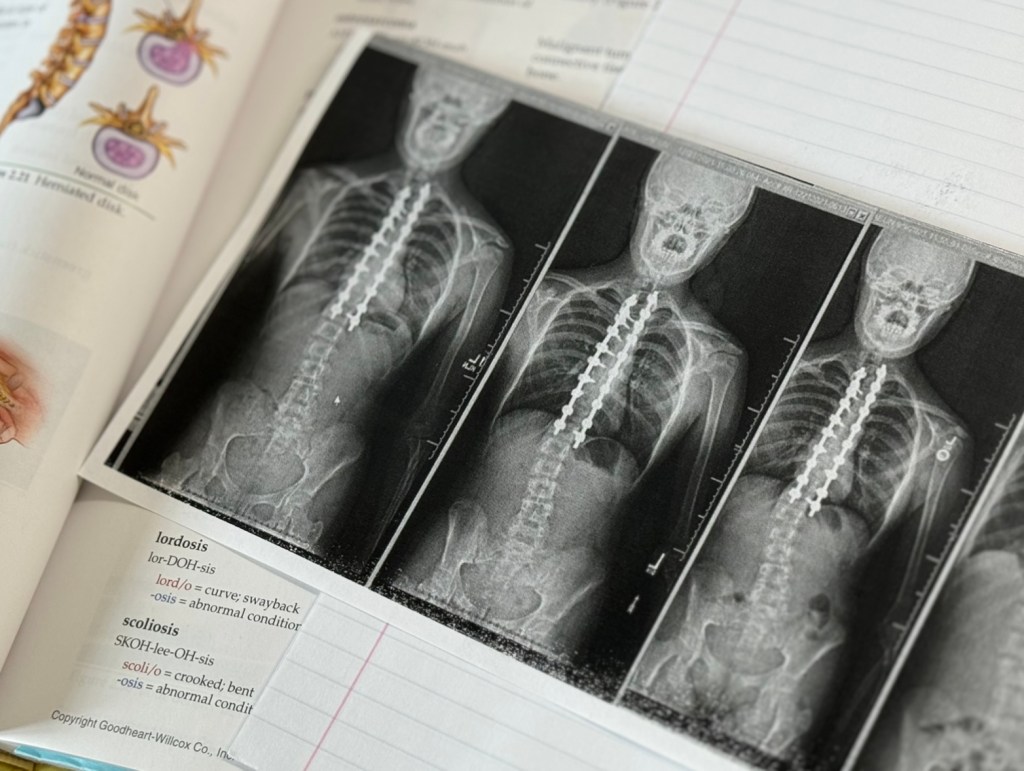
An abnormal curve in the spine is defined as scoliosis, an idiopathic condition that can cause negative health effects. Despite the unproven primary cause of scoliosis, many medical professionals link the disease to heredity and the neuromuscular system. (Photo by Katie Park)
Scoliosis is the abnormal lateral curvature of the spine. Adolescents around the age of 10 are commonly found to develop the condition (1), the time when their growth spurt significantly impacts the curvature of the spine. Scoliosis can be classified as either idiopathic, congenital, or neuromuscular. Idiopathic scoliosis is the unknown cause of spinal curvature. Congenital scoliosis occurs when spinal deformities are present when a baby is born, and is the least common, only affecting 1 in 10,000 newborns (2). Neuromuscular scoliosis is a disorder of the nervous or muscular system, causing muscles to become weak and the spine to curve because of its lack of support (3). Although the etiology of idiopathic scoliosis is currently unknown, there have been many theories.
Genetics and heredity are thought to be a strong reason for the development of scoliosis, but not all cases are directly inherited. 80 percent of scoliosis has been proven idiopathic, but only 11 percent of patients are likely to develop it from genetic factors (4-5).
Other conditions of the bone share similar characteristics of scoliosis, some of which might be directly related to scoliosis. Osteochondroma is the condition of an overgrown bone tumor or mass that can inhibit a growth plate, causing deformity in limbs during childhood or adolescence (6). A study was documented with a 16-year-old patient with osteochondroma in T11 and scoliosis (7). The patient underwent surgery that successfully removed the benign tumor and corrected the thoracolumbar scoliosis. The presence of both scoliosis and osteochondroma in the patient can infer that osteochondromas of the vertebral column may be linked to scoliosis. Paget’s disease is another condition that affects the bone, characterized as a chronic disorder that causes weakness and abnormal growth in bones (8). This disease can lead to several problems including painful and stiff bones, causing deformities such as scoliosis. Another case was studied and was shown to present a theory on a possible cause of scoliosis. According to the National Library of Medicine, “Scoliosis is frequently associated with symptomatic spondylolisthesis, with an incident ranging from 15% to 48%,” (9). Spondylolisthesis is the displacement of a vertebra in which the bone shifts out of its proper position onto the inferior bone. Effects of spondylolisthesis are pain and stiffness in the back, sciatica, and curvatures of the spine, which may lead to scoliosis or hyperkyphosis (10).
The spine can also be affected by muscular or nervous conditions. A case of myasthenia gravis was recorded with a strong connection to degenerative scoliosis. A 62-year-old woman was diagnosed with myasthenia gravis at age 33 and has been receiving treatment ever since (11). The degeneration of her spine due to her old age caused the formation of scoliosis. Nervous conditions such as spinal tuberculosis, poliomyelitis, cerebral palsy, and several others also have a history of patients developing forms of scoliosis (12-14).
Although scoliosis may arise from other medical diseases, deficiencies in the body may cause scoliosis as well. Vitamin D plays a crucial role in regulating the absorption of calcium and phosphorus in the body, facilitates ideal immune system functions, and benefits the growth of bones and teeth (15). A deficiency of Vitamin D may “impact bone mineral density and the development of deformities, such as idiopathic scoliosis of the adolescent,” according to the National Library of Medicine (16).
Melatonin is another key component in spinal health. An experiment was conducted where 90 chickens were observed; 30 were treated with serotonin, 30 with melatonin, and 30 with no treatment. All 30 of the chickens with no treatment developed scoliosis, 22 in the serotonin group, and only 6 in the melatonin group (17). This experiment confirms the effects of melatonin and how a deficiency can cause abnormal muscular and spinal growth.
While the majority of scoliosis cases have no confirmed etiology, scientists and medical experts are researching and conducting experiments to discover possible causes for the abnormal spinal condition, with some theories ranging from complications of a pre-existing condition to deficiencies of normal bodily components.
References
(1) Scoliosis. http://www.hopkinsmedicine.org. https://www.hopkinsmedicine.org/health/conditions-and-diseases/scoliosis#:~:text=In%20more%20than%2080%20percent
(2) Congenital Scoliosis | Boston Children’s Hospital. http://www.childrenshospital.org. https://www.childrenshospital.org/conditions/congenital-scoliosis
(3) Neuromuscular Scoliosis | Boston Children’s Hospital. http://www.childrenshospital.org. https://www.childrenshospital.org/conditions/neuromuscular-scoliosis#:~:text=What%20is%20neuromuscular%20scoliosis%3F
(4) Scoliosis and Hereditary. Scoliosis. https://scoliosisinstitute.com/scoliosis-and-hereditary/#:~:text=Studies%20have%20shown%20that%20individuals
(5) Scoliosis Causes: Is it Hereditary, Genetic, or Environmental? Treating Scoliosis. https://treatingscoliosis.com/scoliosis-causes/#:~:text=treat%20the%20condition.-
(6) Osteochondroma. http://www.hopkinsmedicine.org. https://www.hopkinsmedicine.org/health/conditions-and-diseases/osteochondroma#:~:text=Osteochondroma%20is%20an%20overgrowth%20of
(7) José Alcaraz Mexía M, Izquierdo Núñez E, Santonja Garriga C, María Salgado Salinas R. Osteochondroma of the Thoracic Spine and Scoliosis. Spine. 2001;26(9):1082-1085. doi:https://doi.org/10.1097/00007632-200105010-00019
(8) Paget’s disease of bone – Symptoms. nhs.uk. Published October 3, 2018. Accessed March 14, 2024. https://www.nhs.uk/conditions/pagets-disease-bone/symptoms/#:~:text=Paget%27s%20disease%20of%20bone%20can
(9) Khashab M, AlMaeen BN, Elkhalifa M. Scoliosis Associated with Lumbar Spondylolisthesis: Spontaneous Resolution and Seven-Year Follow-Up. Cureus. Published online February 6, 2020. doi:https://doi.org/10.7759/cureus.6904
(10) Spondylolisthesis and Scoliosis: All You Need to Know. Scoliosis SOS. Published February 22, 2017. Accessed March 14, 2024. https://www.scoliosissos.com/blog/spondylolisthesis-and-scoliosis-all-you-need-to-know#:~:text=Spondylolisthesis%20and%20scoliosis%20%E2%80%93%20what%27s%20the
(11) Hirai N, Hida S, Yo M, Naito M, Kawanami S. Degenerative Scoliosis Associated with Myasthenia Gravis. Orthopedics & Traumatology. 2000;49(4):1166-1168. doi:https://doi.org/10.5035/nishiseisai.49.1166
(12) Chen L, Liu C, Ye Z, et al. Multiple Spinal Tuberculosis with Severe Kyphosis: A Case Report. Frontiers in Surgery. 2022;9. doi:https://doi.org/10.3389/fsurg.2022.815514
(13) Post Polio Syndrome. NORD (National Organization for Rare Disorders). https://rarediseases.org/rare-diseases/post-polio-syndrome/
(14) Cloake T, Gardner A. The management of scoliosis in children with cerebral palsy: a review. Journal of Spine Surgery. 2016;2(4):299-309. doi:https://doi.org/10.21037/jss.2016.09.05
(15) Vitamin D: Benefits, Sources, Deficiencies. Healthline. Published January 14, 2022. https://www.healthline.com/health/food-nutrition/benefits-vitamin-d#:~:text=Vitamin%20D%20has%20several%20important
(16) Alexandru Herdea, Adham Charkaoui, Alexandru Ulici. Prevalence of 25-OH-Vitamin D and Calcium Deficiency in Adolescent Idiopathic Scoliosis. Journal of medicine and life. 2020;13(2):260-264. doi:https://doi.org/10.25122/jml-2020-0101
(17) Machida M, Dubousset J, Imamura Y, Iwaya T, Yamada T, Kimura J. Role of melatonin deficiency in the development of scoliosis in pinealectomised chickens. The Journal of Bone and Joint Surgery British Volume. 1995;77(1):134-138. Accessed March 14, 2024. https://pubmed.ncbi.nlm.nih.gov/7822371/


 Park Medical Research
Leave a comment